Project Proposal: Insights into Government Procurement
Project Motivation
Government Electronic Business (GeBIZ) is Singapore Government’s one-stop e-procurement portal, created to facilitate transparency in procurement requirements, procedure, and evaluation. Purchases can either be centralised (ministries and government agencies will then purchase off service-wide contracts) or decentralised. GeBIZ encompasses the public sector’s request for quotations and tenders within the procurement procedure, except where emergency procurement procedures apply:
| Value | Category | In GeBiz? | Description |
|---|---|---|---|
| Up to S$6,000 | Small Value Purchase | Optional | May purchase direct or off the shelf |
| S$6.000 to S$90,000 | Quotation | Yes | Invitation to quote on GeBiz |
| Above S$90,000 | Tender | Yes | Open, selective, or limited tender |
Summary of Procurement Procedure, source: GeBIZ
Records of Government Procurement via GeBIZ between 1 April 2016 and 31 March 2022 are available on data.gov.sg. In this project, we aim to categorise the products or services from the raw text provided by GeBIZ, thereby generating powerful insights on government procurements. This treasure trove has not been widely explored or utilized (at least publicly) and through a R Shiny application, we seek to explore meaningful insights that can aide anyone looking into government procurements, be it the government agencies themselves, the suppliers keen on participating in government tenders, or even a member of the general public with an interest to see one facet of how tax dollars are spent.
Problems
While the database of historical tenders is extensive, it is not organized or visualized in a manner that allows for patterns or insights to be easily derived without having some knowledge of data analytics methods and applications.
Therefore, our R Shiny application seeks to address this and deep dive into the areas including but not limited to:
- Categorizing the records from its current raw text form; identify goods or services which are required by the government. This is crucial to enable practical use of the dataset by any user group.
Examine and forecast time-series trends in procurement spend; is there any truth in the hypothesis that organizations tend to spend more liberally at the end of budgeting period?
Is there any difference in GeBIZ procurement during the Covid period (identified as April 2020 to March 2022 by the Auditor-General’s Office), when emergency procurement procedures were utilized?
- The dataset from GeBIZ is limited in scope; expand the scope beyond the seven variables
Enrich the dataset by labeling the Ministry which each Government Agency belongs to
Enrich the dataset with additional information on the supplier (i.e. primary industry, paid-up capital)
- Explore any bias in terms of frequency of using the same supplier that could highlight a need to investigate if this is with or without good reason.
Data Description
Data will be drawn mainly from data.gov.sg and supplemented by GeBiz portal and Singapore Government Directory. We will extract the open tenders put out by government agencies from years Jan 2017 to March 2022. The main dataset will consist of 7 columns such as tender description, awarded date, awarded amount, supplier and agency information. We will also be extracting ‘ACRA Information on Corporate Entities’ from data.gov.sg to supplement supplier’s information on industry classification (Primary SSIC code & description) and paid-up capital.
Data Preparation & Story Board
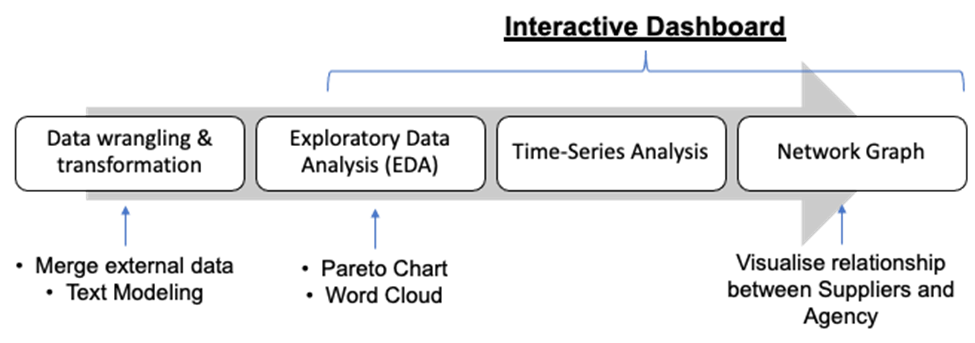
- Data wrangling and Transformation
Merge data from GeBiZ and ACRA into Government Procurement dataset
Use topic modeling to analyze procurement text and determine cluster words relevant to products or services
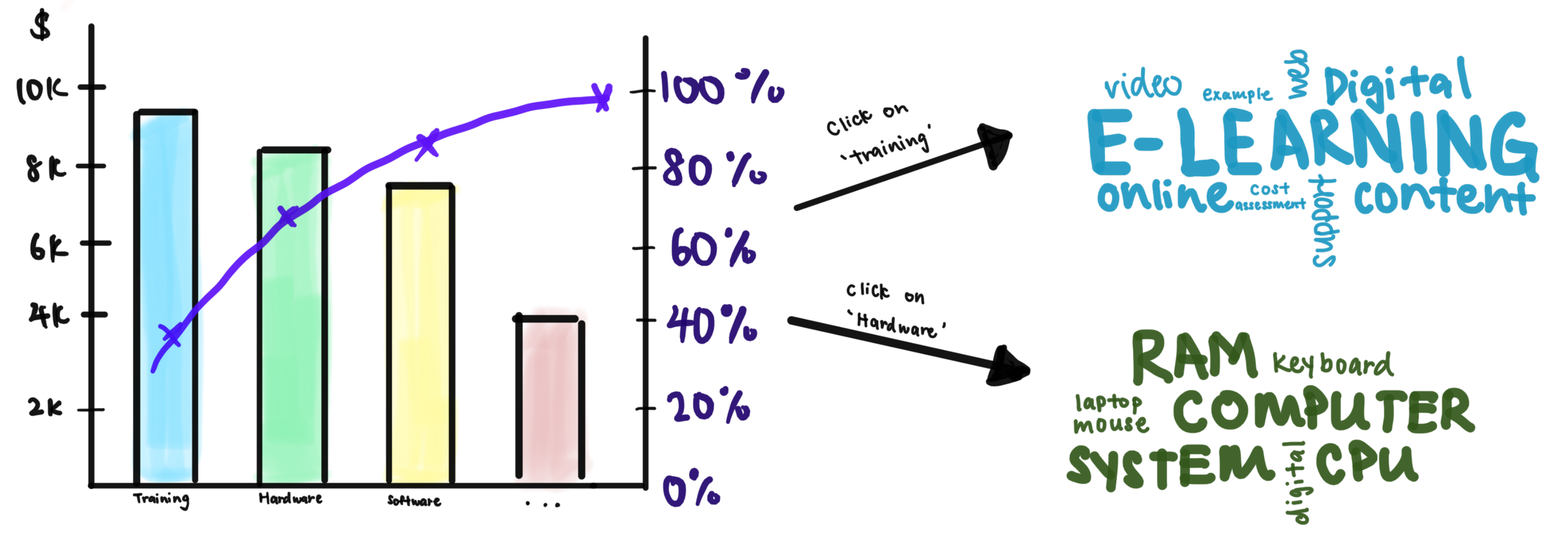
- Exploratory Data Analysis (EDA)
Pareto Charts to visualize total amount awarded on each category
Interactive wordcloud to identify related key words to each category
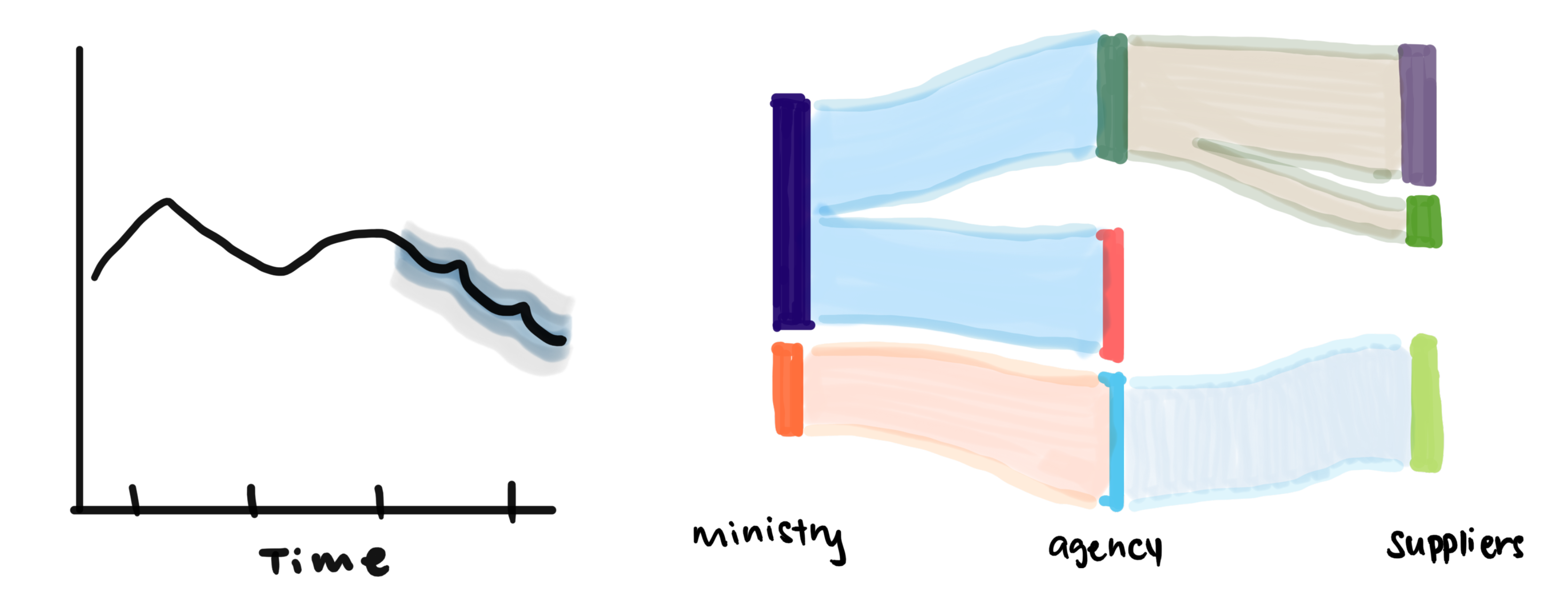
- Time-Series Analysis
Time-series analysis to explore the relationship between calendar year period and volume/value of awarded contracts
Predictive forecast of procurement spending by product / service
Sankey diagram to show flow of spending from ministry to supplier, by procurement category
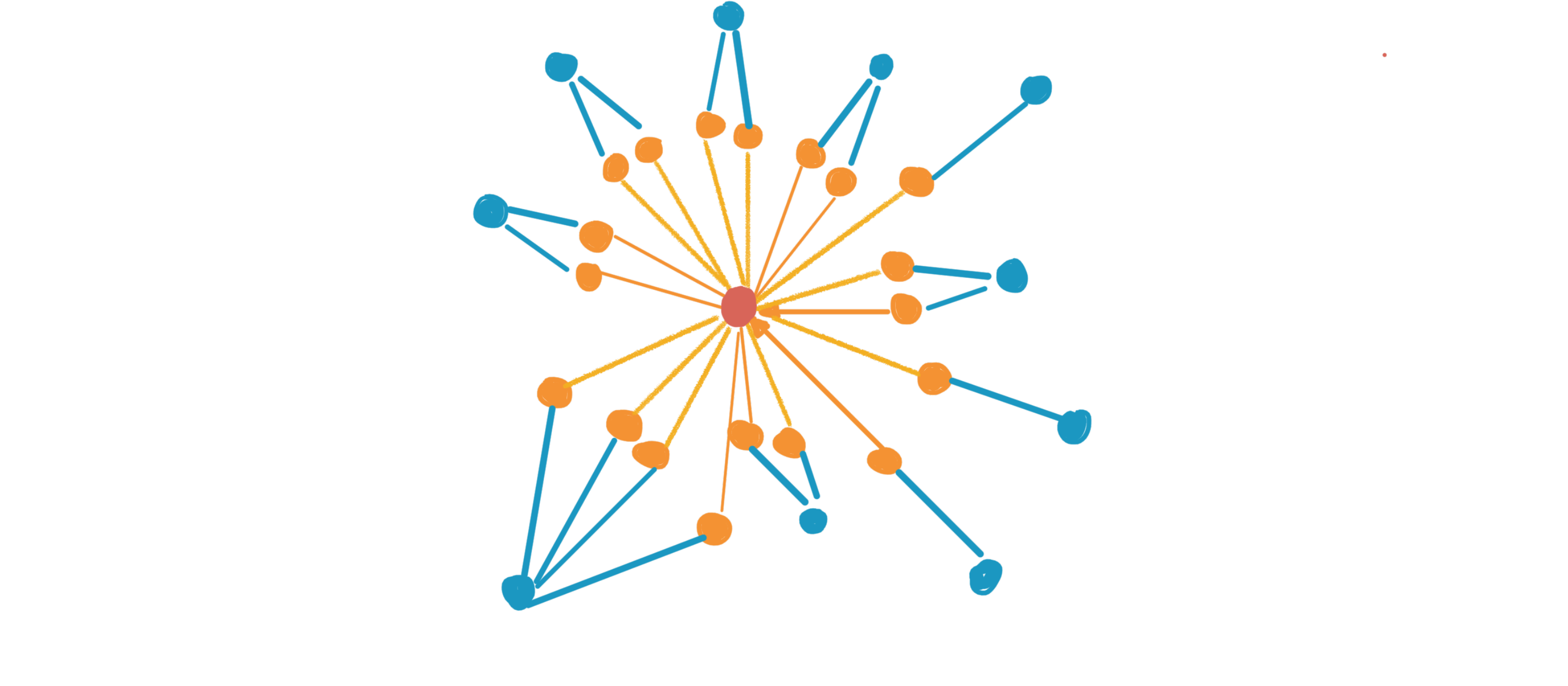
- Cluster Analysis
Network Analysis of the different ministries/agencies vs suppliers to investigate their connectivity and any strong links or bias
R Packages
The software used for this project is R, and the R packages that will be applied for the dashboard application are:
| Packages | Purpose |
|---|---|
| Shiny and Shiny dashboard | To build interactive web application and visualisations |
| Spacyr | To tokenize and tag common product or services |
| Tidyverse | To tidy up and manipulate the data |
| Plotly | To create interactive graphs |
| ggplot2 | To create static graphs |
| knitr | Dynamic report generation with R |
| ggstatsplot | To create graphics with details from statistical tests |
| visNetwork | To create network visualization |
| tm_map, wordcloud2 | To create word cloud |
| crosstalk | To link different plots |
| LDAvis | To visualize and interpret topic models |
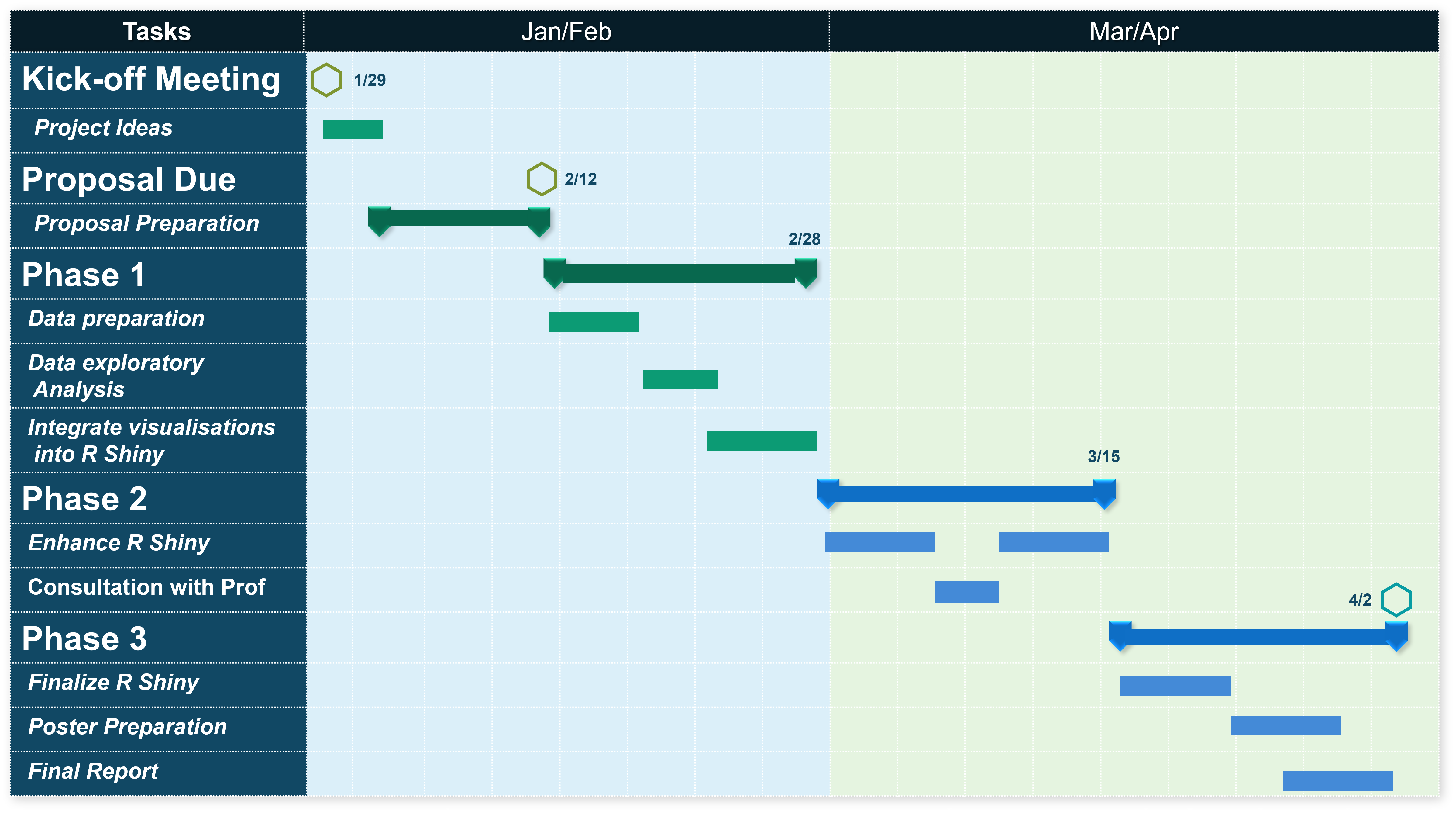
Project Milestones
References
Auto, H. (2022, July 20). Auditor-General’s Office report: 8 key findings | The Straits Times. www.straitstimes.com. https://www.straitstimes.com/singapore/eight-key-findings-in-agos-report
GeBIZ | Guide to Singapore Procurement. (n.d.). www.gebiz.gov.sg. https://www.gebiz.gov.sg/singapore-government-procurement-regime.html
Group17 Overview - Visual Analytics and Applications. (n.d.). Wiki.smu.edu.sg. Retrieved February 12, 2023, from https://wiki.smu.edu.sg/1718t3isss608/Group17_Overview
Government Procurement. (n.d.). MOF. Retrieved February 12, 2023, from https://www.mof.gov.sg/policies/government-procurement